
Understanding Clinch County Releases
A release from Clinch County Jail means local custody ended. It does not always mean the person went home or that the criminal case closed. The sheriff may discharge someone on bond, under a court order, after time served, at the end of a local sentence, or for transfer to another custodian. A person transferred to the Georgia Department of Corrections has left the county jail but remains confined. A federal or immigration hold can produce the same result: the local booking ends while another agency takes custody.
The record trail follows that distinction. Sheriff Raymond Peterson's office operates the Clinch County Jail and keeps the local jail record. The courts document bail, disposition, and sentence orders. GDC tracks people sentenced to state custody. The Georgia State Board of Pardons and Paroles and Department of Community Supervision track parole and felony probation. BOP, ICE, and the U.S. Marshals Service are separate federal lanes. Identifying the last legal custodian prevents the common error of treating every departure from jail as release to the community.
Clinch County Release Paths
The reason for release and the destination answer different questions. A short local record may show only the order and court behind discharge, so court or receiving-agency records may be needed to complete the path.
| Release path | Meaning and next record |
|---|---|
| Bond | The person leaves jail under bail conditions while the case continues; check Magistrate or Superior Court records. |
| Time served or sentence end | Local confinement is complete; confirm the sentence and credit in the court file. |
| Court order or dismissal | The jail acts on an order; the court docket explains the legal basis and whether charges remain. |
| Transfer to GDC | County custody ends, but state custody begins; use GDC Offender Query. |
| Parole | Prison custody ends under Board authority and community supervision may continue through DCS. |
| Federal or immigration transfer | Follow BOP, USMS, or ICE records only when case facts show that custodian is involved. |
Clinch County Release Record Fields
Georgia law gives the local discharge record unusual value. O.C.G.A. 42-4-7 requires the sheriff to keep a record of people committed to the county jail. The required facts connect admission, legal process, charge, and discharge. This matters because no official Clinch County current roster or release archive was found online. The statutory record can establish that a named person left the jail even after a live custody entry is gone.
| Field | What it establishes |
|---|---|
| Name and commitment | Who entered custody and when the jail received the person. |
| Process and court | The warrant, order, or other authority and its issuing court. |
| Charge | The allegation tied to the local commitment, not necessarily the final disposition. |
| Day of discharge | The date local jail custody ended. |
| Discharge order | The authority for release or transfer. |
| Issuing court | The court whose file may explain bail, sentence, dismissal, or another outcome. |
A complete request should also ask for the release time, release reason, bond or court-order information, booking date, and any transfer destination if those fields exist in the maintained record. An agency need not create a new report that does not exist, so naming the existing booking and release record is more effective than asking the sheriff to conduct an open-ended investigation.
Request Clinch County Release Records
The Clinch County Sheriff's Office is the first records contact for a local jail event. The official office and jail address is 115 Court Square, Homerville, GA 31634. The main number is 912-487-5316, and the fax number is 912-487-3602. A narrow, purpose-neutral request reduces ambiguity and helps the office locate the correct booking.
- Give the person's full name and any reliable spelling variation.
- Provide the approximate booking or release date and identify Clinch County Jail.
- Ask for the booking and release record, including discharge date, time, reason, order, court, and transfer destination.
- Ask whether fees or clarification are required before production.
- Compare the response with the related court docket or receiving-agency record.
Georgia's Open Records Act generally requires an initial response within three business days when a request is received during normal hours. The response may provide records, explain when they will be available, state lawful grounds for withholding material, or estimate permitted costs. Search, redaction, production, copying, and media costs may apply. The rule is a response framework, not a promise that every record will arrive in three days.
Clinch County Discharge Record Law
O.C.G.A. 42-4-7 both defines key county jail record fields and makes the record subject to examination under Georgia public-records law. The Governor's Open Records Act overview explains that public records include paper and electronic material prepared, maintained, or received by an agency. It also confirms that an office does not have to make a new report when no such report exists.
Access is not the same as permanent online display. Some information may be withheld or restricted by law, and juvenile matters require special care. Georgia uses the term record restriction for many matters often called expungement. Under O.C.G.A. 35-3-37, certain criminal-history records may be restricted after the required approval and process. A missing web result therefore does not prove that no arrest, booking, or release occurred. Older paper files, spelling differences, restricted records, juvenile handling, and limited portal coverage can all affect visibility.
Clinch County Bond Release Records
Bond-out research should include Clinch County Magistrate Court. The county describes that court as handling warrants, preliminary hearings, arrest and search warrants, minor and felony criminal matters, and bail when the issue is not reserved exclusively to another court. Its office is at 110 Court Square in Homerville, with Magistrate Court reached at 912-487-2514.
Bond release is not a finding that the case ended. It means the person left custody subject to the bond and any court terms. The jail discharge line establishes when local custody ended, while the Magistrate or Superior Court file can show the bond order and later case activity. This two-record check guards against reading “released” as “charges dismissed.” If the case advances to Superior Court, the Clerk of Superior Court maintains criminal case and warrant records at 25 Court Square, Suite C.
Clinch County Jail Report Caveat
The Georgia Sheriffs' Association publishes a monthly statewide Jail Report, but the captured June 2026 table showed a Clinch jurisdiction row without populated figures. That blank row is not proof of zero jail bookings, zero people in custody, or zero releases. It is also not a person-level lookup. The sheriff's statutory jail record and the court file remain the useful sources for a named release.
Find a Released Clinch County Inmate
Start with custody type, not a broad name search. Clinch County does not appear to publish an official current roster, 24-hour release list, 72-hour release list, or archive on the sheriff page reviewed. The absence of a name from an unfound feed proves nothing. A reliable search moves from the local jail record to court, state, supervision, or federal records as the facts require.
- Call the Clinch County sheriff and jail to ask whether local custody ended or a transfer occurred.
- Request the booking and discharge record if verbal confirmation is limited.
- Check Magistrate or Superior Court for the bond, disposition, sentence, warrant, or transfer order.
- Search GDC when a felony sentence or state transfer is possible.
- Use the parolee database, DCS, or Georgia VINE when supervision or a status alert is relevant.
- Use BOP, ICE, or USMS only when a federal or immigration custody fact supports that route.
GDC Search for Clinch Releases
The Georgia Department of Corrections Find an Offender page leads to the state-prison search lane shown below. It is not the correct tool for a person released only from Clinch County Jail. Search by name or GDC identifier, then read the sentence status and detail page. The public form includes a “Released In The Past 15 Days” sentence-status filter, which is wider than a local same-day or three-day feed.
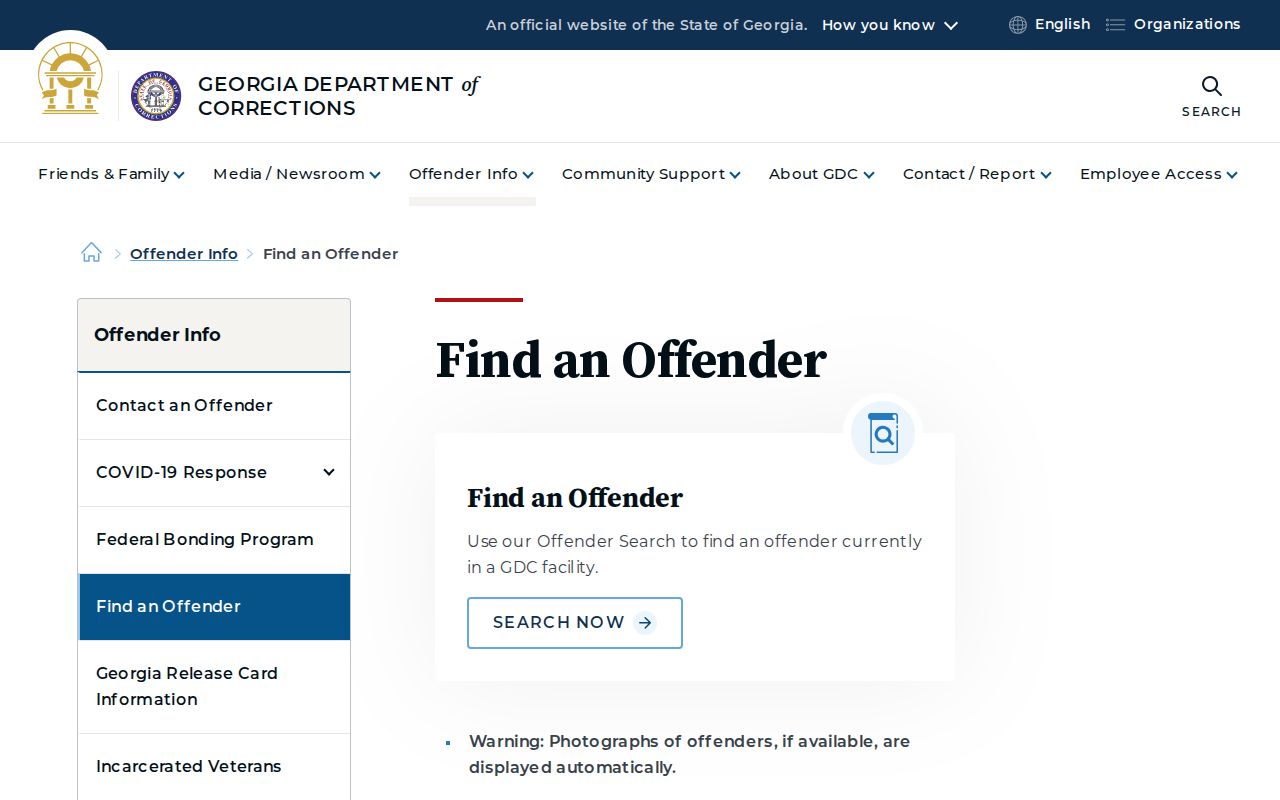
The captured state page identifies the official GDC search route, which applies to state custody rather than a county-jail-only release.
| Search or result field | Use |
|---|---|
| First and last name | Find possible state-offender matches; test spelling carefully. |
| GDC ID | Distinguish people with similar names. |
| Sentence status | Narrow to active records or people released in the past fifteen days. |
| Most recent institution | Identify the last state facility, which may not be in Clinch County. |
| Max possible release date | Shows sentence expiration as calculated by GDC, not a guarantee of actual release. |
| Actual release date and status | Confirm a past GDC discharge and whether the state record is inactive. |
The detail page may also show a photo, physical description, and major offense. Actual release can precede the max possible date because of Parole Board action. County jail time before conviction and sentencing can be credited in GDC's calculation. Always match the identity fields and distinguish a future max date from an actual release date.
Clinch Release and Court Lookup
Court interplay is especially important in Clinch County. Magistrate Court may handle the warrant, first stages, preliminary hearing, and bail, while the Clerk of Superior Court maintains the felony case and criminal warrants on the superior-court side. Georgia Courts E-Access lists Clinch Superior as connected to PeachCourt, though online access may require an account and may not include every image.
Look for the charge filed, accusation or indictment number, plea, verdict, dismissal, nolle prosequi, sentence date, confinement term, probation term, jail-time credit, bond orders, and revocation orders. Nolle prosequi means the prosecutor formally chose not to pursue a charge at that point. It is not the same record as jail discharge. Reconcile the two: the jail entry shows when custody ended; the court docket shows what happened to the case.
Clinch County Release Supervision
Parole and probation do not mean the same thing. Parole follows release from a prison sentence by action of the State Board of Pardons and Paroles. Probation is a court-ordered sentence served in the community, sometimes after confinement. DCS handles field supervision for parole and felony probation. The Lakeland Virtual Office serves Clinch and other Alapaha Circuit counties from P.O. Box 633, Lakeland, GA 31635, with phone 229-569-5051.
The Board's parolee search may show a released person's supervision information. The Inmate TPM Lookup serves a different purpose: a Tentative Parole Month is a review and planning month, not proof of release. A person can also have completed custody but remain under supervision. The fuller distinction and verification route appears in Post-Release Supervision.
Funds After a GDC Release
GDC describes a Georgia Release Card used to transfer remaining funds from a released state prisoner's account. This is a practical state-release detail, not a Clinch County jail record or proof of discharge. Questions about the card belong with GDC, while the actual release date and inactive status remain part of the offender record. Keeping those functions separate helps route a post-release concern to the office that can address it.
Clinch Release Alerts and Federal Custody
Georgia VINE offers notification-based custody information. It can help monitor a status change, but it is not a permanent Clinch County release archive. Search Georgia by name or identifying information, inspect the agency and status, and register for an alert when offered. Data can lag the event, so a notification should be checked against the jail or corrections record.
Federal custody needs its own source. BOP covers sentenced federal inmates from 1982 to the present. A past BOP release date with no facility shown means the person is no longer in BOP custody, though another form of custody or supervision may continue. USMS handles many federal pretrial and transport cases and may house prisoners in local facilities. ICE's locator is appropriate only when immigration detention is supported by case facts. No reviewed source identifies Clinch County Jail as an ICE contract detention site.
Clinch Custody Status Sources
Each system answers a limited question. Checking the wrong one can make a transfer look like freedom or make a released person seem missing.
| Source | Best use | Key limit |
|---|---|---|
| Clinch County Jail record | Local booking and discharge | No official online roster or release feed was found. |
| Clinch court record | Bond, disposition, sentence, and orders | A case may continue after jail release. |
| GDC Offender Query | State custody, max date, actual release, status | Does not cover a local-only jail release. |
| Parole Board and DCS | Parole or felony probation after release | Supervision is not the same as confinement. |
| BOP, USMS, or ICE | Supported federal or immigration custody | Not a general Clinch County jail search. |
Clinch Releases and Record Restriction
Georgia record restriction can change what appears in public-facing criminal-history channels. It does not turn every older jail or court event into a searchable web result, and it does not justify assuming that a missing record means no event occurred. Eligibility depends on the record, disposition, approval, and state law. The Georgia Courts self-help material and GBI process information are the proper starting points for a person seeking restriction or a criminal-history update.
Historic Clinch Jail Is Separate
Local history describes the Old Clinch County Jail as an 1894 building that served until 1927 and was later saved from demolition by the Homerville Woman's Club. The county government history and New Georgia Encyclopedia county entry give broader Clinch context, but none of these sources is a current custody channel. Modern Clinch County jail records route to the sheriff and jail at 115 Court Square.
Clinch County Release Facilities
Clinch County Jail is the local booking and discharge source. Georgia Department of Corrections facilities hold people serving state sentences. The DCS Lakeland Virtual Office supervises parole and felony probation but holds no inmates. Federal BOP facilities, ICE detention facilities, and USMS prisoner custody are separate federal tracks. Their facility pages explain the correct release source and why a local jail discharge may be only one step in the custody path.
- Clinch County Jail: local release, bond, court order, sentence end, or transfer.
- Georgia Department of Corrections: state-prison status and discharge.
- DCS Lakeland Virtual Office: community supervision after release.
- Federal Bureau of Prisons: sentenced federal custody.
- ICE detention and ODLS: immigration custody when supported by the facts.
- U.S. Marshals Service: federal pretrial, placement, and transport custody.