
Clinch Parole and Probation Compared
Parole and probation can both place a person under rules in the community, but they begin in different ways. Parole is a conditional release from a Georgia Department of Corrections sentence. The Georgia State Board of Pardons and Paroles decides whether an eligible state prisoner will be released before the maximum sentence expires. Probation comes from the sentencing court. A judge may order it instead of confinement, after a confinement term, or as part of a split sentence. Georgia’s Department of Community Supervision, known as DCS, provides community supervision for parole and felony probation.
The distinction matters when checking a Clinch County case. A county jail discharge record may show that the person left local custody, but it does not by itself show whether parole or probation began. A GDC detail record may show an actual release date and inactive prison status. The Board’s parolee database is the more direct public channel for a person already on parole. A court sentence and DCS are the better sources for felony probation.
| Point | Parole | Probation |
|---|---|---|
| Who orders it | Georgia State Board of Pardons and Paroles | Sentencing court |
| When it begins | After release from a parole-eligible state prison sentence | As directed by the sentence, sometimes after confinement |
| Best record | Board parolee lookup and release decision | Court disposition and DCS confirmation |
| Local contact | DCS Lakeland Virtual Office for Clinch County supervision logistics | |
- Parole
- Conditional community release before the maximum state prison sentence ends.
- Probation
- A court-ordered sentence served under stated rules in the community.
- Discharge
- The formal end of custody or supervision, not merely a move between agencies.
- Absconder
- A supervised person alleged to have stopped reporting or left supervision without permission.
Check Clinch Post-Release Supervision
Begin with identity, not assumptions. Use the full name, date of birth or age, GDC ID, and the court case number when known. Similar names can point to different people. Also determine whether the person left the Clinch County Jail, a GDC institution, or another custodian. A transfer out of the county jail can look like release even when custody continues at a state prison or another agency.
- Check the Georgia Parole Board public tools. Use the Inmate TPM Lookup for a person still in prison and the Parolee Database for someone believed to be on parole.
- Search the GDC Offender Query with an all or inactive scope. Compare the GDC ID, most recent institution, actual release date, and current status.
- Read the Clinch sentencing record. The Clerk of Superior Court maintains criminal cases and can help locate the sentence that created probation.
- Contact the DCS Lakeland Virtual Office for the office serving Clinch County. Ask about the correct office and process, while recognizing that staff may limit personal case details.
- For proof that local jail custody ended, request the booking and discharge record from the Clinch County Sheriff. The county record and supervision record answer separate questions.
A Tentative Parole Month, or TPM, is not a firm release date. The Board completes a final review around that month and may set a release date if the person remains eligible and meets any program requirements. Use the Clinch County release date lookup to separate a maximum date, a TPM, and an actual release date.
Clinch Supervision Through Lakeland
Clinch County does not have a Clinch-branded DCS office in the research record. The DCS Lakeland Virtual Office serves the Alapaha Circuit counties of Atkinson, Berrien, Clinch, Cook, and Lanier. This state-centered arrangement is the practical local path for parole and felony probation questions after release. It also prevents a common mistake: calling the county jail for supervision details that belong to DCS or the Parole Board.
Lakeland, Department of Community SupervisionP.O. Box 633
Lakeland, GA 31635
Phone: 229-569-5051
Fax: 478-216-2154
Monday-Friday, 8:00 a.m.-4:30 p.m.
The DCS listing names Coordinating Chief Ryan Smith. Call before trying to visit because the source identifies this as a virtual office and provides a post office box, not a public street counter. For a court document, contact the clerk instead. For a parole decision, use the Board. For the fact and reason of county jail discharge, contact the sheriff.
Clinch Supervision Status and Violations
Conditions are the rules attached to supervision. They may include reporting, travel limits, payments, treatment, or other case-specific duties. Do not infer a person’s exact conditions from the fact that parole or probation exists. The written parole certificate, probation sentence, and current DCS instructions control. A violation allegation also does not by itself show the final result. DCS, the court, or the Board may address it through a warrant, hearing, sanction, revocation, or another action.
An absconder is generally a person alleged to have stopped reporting or left supervision without approval. Public status tools may not contain the full warrant file. If a record indicates a supervision problem, compare it with the court docket and the responsible state agency. Georgia VINE can provide custody-change alerts when a participating feed has the person, but it is not a probation case file. A new arrest or detainer may also change which agency holds the person.
How Clinch Supervision Ends
Supervision ends through a formal legal event. A probation term may expire or be terminated by a court order. Parole may end at discharge under the Board’s authority or when the governing sentence is complete. The absence of a current online result is weaker evidence. Name spelling, restricted records, older files, or a limited database can all affect what appears online.
Build the record from the agency that created each event. The Clinch County released-inmate search explains how to request the sheriff’s statutory discharge record, which includes the day of discharge, discharge order, and issuing court. For state prison, use the GDC actual release date and status. For probation, obtain the sentence and any later termination order. For parole, use the Board record and DCS office. Together, those records distinguish release from custody from discharge off supervision.
Georgia calls many forms of expungement “record restriction.” A restricted public-facing record does not mean that no arrest, sentence, release, or supervision event ever occurred. It means access may be limited under the applicable order and law. Seek a certified court record when the legal effect matters.
Clinch Parole Timing Records
Georgia uses two distinct public timing concepts. GDC labels the sentence-expiration field “Max Possible Release Date.” The Parole Board uses “Tentative Parole Month.” Neither should be reported as a guaranteed day the person will enter the community. The maximum date reflects the longest-running sentence and credit for county jail time before conviction and sentencing. A TPM marks the period for final Board review.
The Board's parole process says most parole-eligible state inmates are automatically considered and generally become eligible after serving one-third of a sentence. That is not a universal release rule. The eligibility guidance addresses exclusions and detainers, while the decision guidelines explain recommendations that the Board may accept or reject. Misconduct or unmet program requirements may postpone or cancel a TPM.
The TPM Lookup explanation shows why parole timing must stay separate from probation and county earned time.
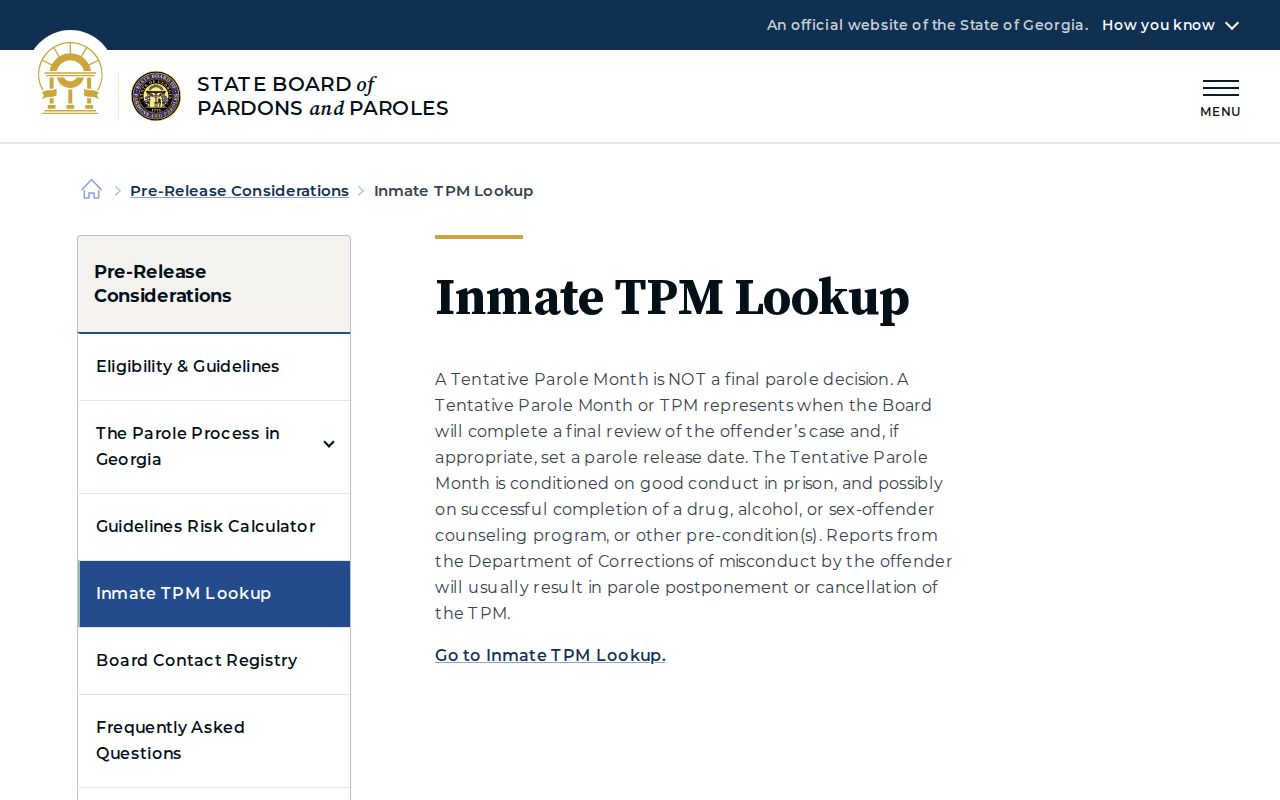
The captured Board page is a source for the meaning of a TPM, not proof of an individual release.
Clinch Reentry Is State-Centered
Clinch’s supervision and reentry path is state-centered rather than built around a county parole office. DCS assigns Clinch to its Lakeland Virtual Office with five other Alapaha Circuit counties. The Parole Board maintains parole status, and GDC maintains the prison and release record. The county jail confirms only the local custody event. Routing each question to its record owner avoids expecting sheriff staff to resolve a parole condition or expecting DCS to produce a jail discharge order.
For a released person reconnecting with family or arranging required reporting, confirm the DCS office before travel. The virtual-office label and post office box make a phone check especially useful.
Georgia Release Cards After Prison
GDC’s Georgia Release Card information addresses one practical detail after state-prison release. Remaining funds on a released person’s account are transferred to a card for use after release. The card does not show parole status, probation terms, or a release date, and it is not part of the Clinch jail roster. It belongs to the state-prison release path.
This detail helps distinguish immediate release logistics from legal supervision. Questions about card funds go to the GDC channel, while reporting instructions and conditions come from DCS or the Parole Board.
Clinch Parole Cases and Meetings
Georgia does not publish a simple Clinch County calendar of public hearings for each parole case. A published operational meeting notice says offender cases are not discussed or considered during those meetings. Board members vote on parole cases electronically each day. A person seeking case status should use the inmate TPM lookup or parolee database, not attend an operational meeting expecting an individual decision.
Possible results include a TPM, denial, reconsideration, a final release date, postponement, cancellation, or withdrawal before release. Those terms mark different stages. A TPM is preliminary. A final parole release date follows later review if the Board decides release is appropriate. The Board may also revise its action before the effective date.
The Board press-release page remains useful for operational meeting notices and agency policy updates.
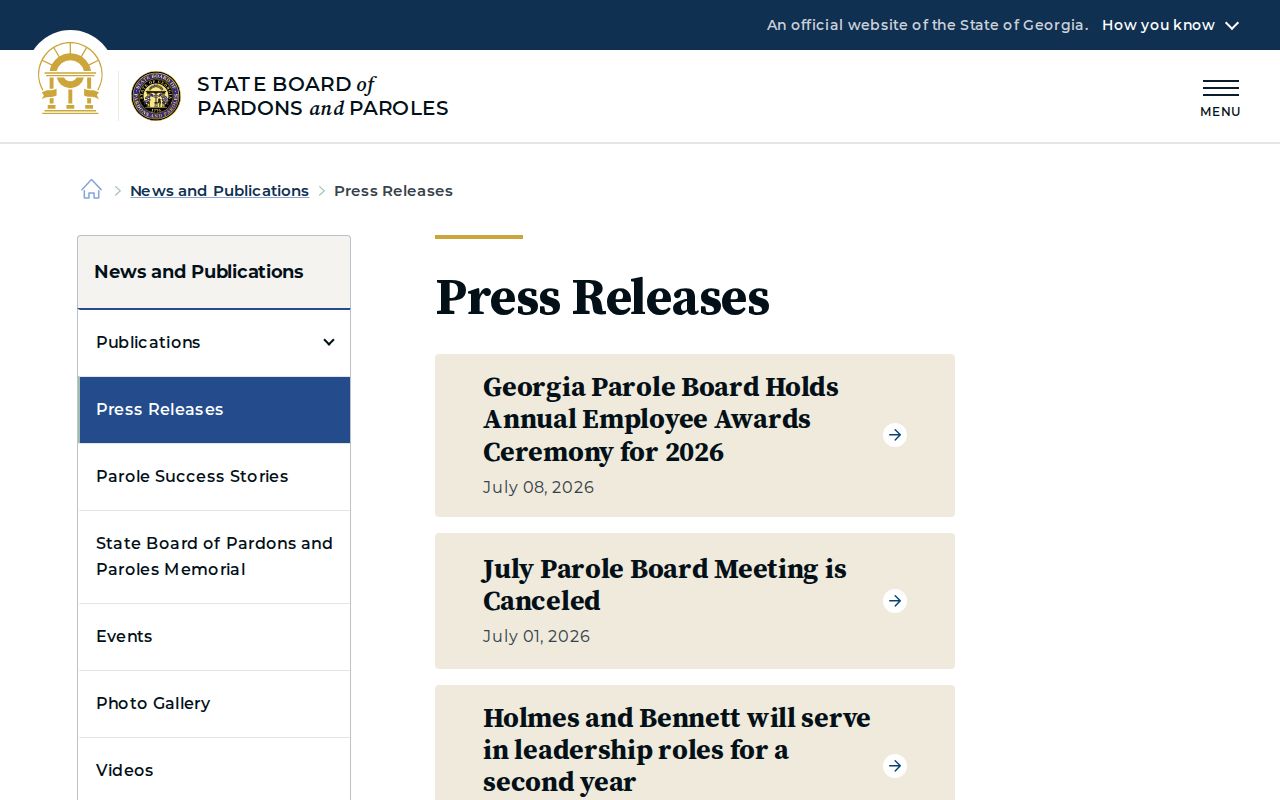
The meeting notices provide agency context, while the person-specific lookup tools remain the right status channel.