
Clinch Projected and Actual Dates
A projected date is a calculation or planning marker. An actual release date records an event that already occurred. Georgia’s state offender detail uses “Max Possible Release Date” for the expiration of the longest-running sentence, with credit for county jail time before conviction and sentencing. A released GDC record may also show “Actual Release Date” and an inactive status. Those fields should not be collapsed into one date.
Parole introduces a third concept. The Georgia State Board of Pardons and Paroles may publish a Tentative Parole Month, called a TPM. The Board says a TPM is not a final release decision. It is the time for final review, after which a release date may be set if appropriate. Conduct and required programs can affect that decision.
A person awaiting trial at Clinch County Jail may have no fixed date at all. Bond can permit release while the case continues. A dismissal, court order, time-served ruling, detainer, or transfer may also control the next event. Check the court record rather than trying to compute a date from the booking alone.
Find a Clinch Release Date
First determine whether the person is in local jail, GDC, or another system. A transfer from Clinch County Jail to state custody is a discharge from the local facility, but it is not release to the community. Use the person’s full name, date of birth or age, GDC ID, and court case number when available.
- For a state prisoner, open GDC Offender Query, accept the disclaimer, and search by name, GDC ID, or case number.
- Use all or inactive scope when the person may already be released. Avoid filters that could hide a spelling or institution mismatch.
- Open the detail record and compare the GDC ID, most recent institution, Max Possible Release Date, Actual Release Date, and Current Status.
- Check the Board’s TPM Lookup separately if parole timing may apply.
- For a county sentence, contact the Clinch County Sheriff and request the commitment and discharge record. Also obtain the sentence from the proper court.
- For an actual event, compare the planned date with the agency’s later release or discharge entry.
The Clinch County release-record hub explains how to request local records. Georgia law requires the sheriff’s county jail record to include the day of discharge, the discharge order, and the issuing court. Those fields can explain why a predicted date did not become the actual date.
The GDC search interface is shown in this captured source.
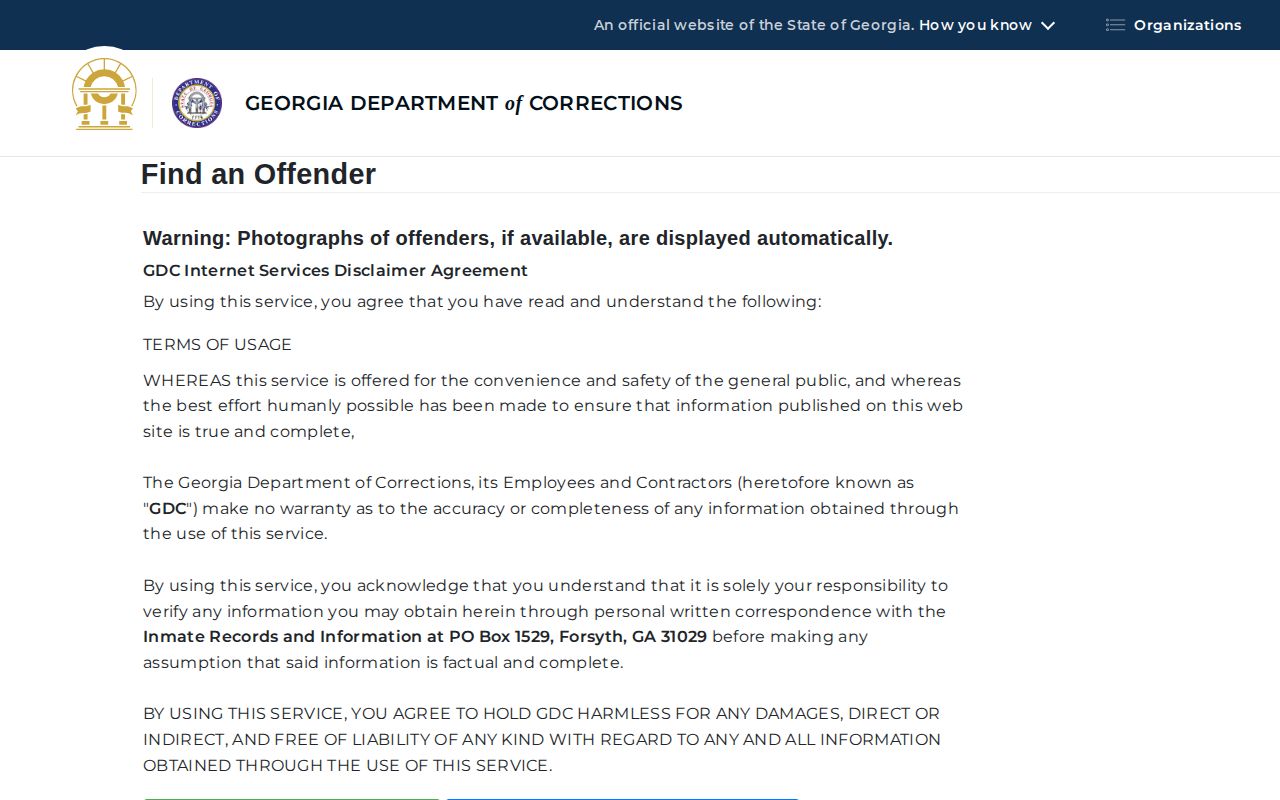
The detail record reached through that search, rather than the search list alone, contains the release fields needed for comparison.
Clinch County Earned-Time Rules
Local jail earned time and state-prison parole timing are separate systems. O.C.G.A. 42-4-7 allows a sheriff, chief jailer, warden, or designated custodian to award earned-time allowances to eligible county inmates based on institutional behavior. For covered county sentences, release occurs at sentence expiration less the awarded deductions. The statute also says earned time is not automatic for crimes committed on or after July 1, 2000.
A court sentence supplies the starting point. Jail staff apply authorized credit and maintain the commitment and discharge record. County time served before a state sentence can also affect GDC’s maximum date. GDC explains that its Max Possible Release Date uses the longest-running sentence with credit for time spent in county jail before conviction and sentencing.
Georgia’s reviewed sources do not support a single “85 percent” rule for every sentence. Most parole-eligible state inmates are generally eligible for consideration after one-third of the prison term, but specified serious violent offenses, certain repeat offenders, and life without parole are excluded. Board guidelines may use months to serve or a sentence percentage, and the Board can accept or reject the recommendation.
Note: Do not subtract an assumed credit from the sentence. Ask the custodian for the official computation and later actual release record.
Why Clinch Release Dates Change
Dates move because different authorities control different parts of the sentence. A jail calculation can change after a corrected order. A parole decision can change before its effective date. A detainer, meaning another agency’s request to hold or receive the person, can change the destination without changing the fact that one facility discharged the person.
| Factor | Possible effect | Confirm with |
|---|---|---|
| County earned time | An awarded deduction may reduce an eligible local sentence. | Clinch County Sheriff |
| County jail credit | Credited pre-sentence time can affect GDC’s maximum date. | Court and GDC |
| Misconduct or programs | A TPM can be postponed or canceled. | Parole Board |
| Parole action | Grant, denial, revision, or withdrawal changes expected timing. | Parole Board |
| Detainer or transfer | The person may leave one custodian but enter another. | Sending and receiving agencies |
| Court action | Correction, appeal, revocation, or new order can change the calculation. | Clerk and custodian |
A parole “to the detainer,” sometimes called conditional transfer, does not necessarily mean the person walks out to the community. The receiving authority may take custody. Ask for both the release reason and destination.
Confirm a Clinch Release Date
For local jail custody, contact the Clinch County Sheriff at 912-487-5316 or request records at 115 Court Square, Homerville, GA 31634. Ask for booking date, release date and time, release reason, discharge order, issuing court, and receiving agency if transferred. The sheriff’s official page does not publish a current roster or recent-release archive, so a direct inquiry or open-records request is the reliable local path.
For GDC, compare the actual release date with current status and most recent institution. GDC’s “Released In The Past 15 Days” filter can help with a recent state release, but it does not cover every release from Clinch County Jail. For parole, distinguish the TPM from a later final release date. For probation, read the court sentence and any termination order.
Register through the Georgia VINE inmate check when a matching record offers notifications. An alert is useful for a pending custody change, but it is not a certified release record. Confirm important dates with the agency that created them.
Three Clinch Release Clocks
Clinch County research produces three related clocks that should never be swapped. The county jail clock applies the sentence and any earned-time allowance under O.C.G.A. 42-4-7. The GDC clock reports the Max Possible Release Date for a state sentence. The Parole Board clock uses a Tentative Parole Month for final review.
Each clock can end with a different event. A county sentence can expire and produce a sheriff’s discharge. A GDC maximum date can mark sentence expiration, though an actual release may occur earlier through parole. A TPM can pass without community release if the Board postpones, cancels, or does not set the final date.
Use the record label exactly as the agency uses it. When sharing a date for a personal, court, or records-correction purpose, state whether it is maximum, tentative, scheduled, or actual. That small distinction prevents a planning estimate from being mistaken for proof.
Clinch Bond Has No Fixed Date
Magistrate Court may grant bail in matters not reserved to another court and handles warrants and preliminary hearings. A pretrial person can therefore leave the jail once bond conditions are met, even though no sentence-expiration date exists and the case continues. The booking date cannot be used to predict the bond release day.
The jail discharge record should identify when local custody ended and the order behind it. The court file can show the bond order and later case events. Superior Court records are maintained by the Clerk of Superior Court, while Magistrate Court handles the lower-court and bail functions described in the county source.
A person who disappears from the jail may also have transferred to GDC after sentencing. Search the receiving system before calling the local event a release to the community.
When planning around an expected release, record the exact label and the date each agency displayed. Recheck close to the event because court corrections, parole review, misconduct, program completion, or a receiving-agency hold can change the result. After the expected day passes, look for an actual release entry rather than repeating the old projection. If none appears, ask whether the person remained in custody, transferred, or was released under a different legal event.
Build a Clinch Release Timeline
A reliable release timeline usually needs more than one date. Start with the court sentence because it states the confinement term, probation term, sentence date, and any credit for time served. Then compare the custodian’s computation. For a county sentence, the sheriff applies any authorized earned-time allowance and records the discharge. For a state sentence, GDC calculates the Max Possible Release Date and later may post an Actual Release Date. The Parole Board separately controls tentative and final parole timing.
Look for the event that explains each change. A bond order can authorize pretrial release while the case continues. A sentence can credit days already spent at Clinch County Jail. A revocation order can return a supervised person to custody. A corrected sentence or appeal can alter the term. A detainer can send the person to another agency on the day one custodian releases them. Listing these events in date order helps distinguish a calculation change from a transfer or completed discharge.
For the local record, ask the sheriff for the commitment date, day of discharge, discharge order, issuing court, release reason, and receiving agency. O.C.G.A. 42-4-7 specifically supports the discharge fields. For the case record, the Clerk of Superior Court maintains criminal cases and warrants, while Magistrate Court handles bail and preliminary matters within its authority. Georgia Courts E-Access identifies Clinch Superior as a PeachCourt-connected court, though direct clerk contact may still be needed for an image or certified copy.
For state records, do not stop at the search-results list. Open the GDC detail record and match the ID before recording a date. The result list shows name, major offense, and institution, but the detail view contains the maximum date, actual date, status, and most recent institution. GDC also provides a “Released In The Past 15 Days” filter for recent state releases. That filter does not include people who left Clinch County Jail without entering GDC custody.